1.Introduction
Fiber-reinforced composites have been widely used in key load-bearing components in aerospace, architecture, transportation and other fields due to their excellent mechanical properties. However, their multiphase composition and complex reinforcement structures result in significant multiscale characteristics, making it difficult to accurately predict their mechanical responses and failure behaviors under external loads using single-scale models. The mechanisms underlying crack propagation and evolution at different scales and theirinfluence on the macroscopic mechanical properties of materials still remain insufficiently understood,yet they are crucial for the reliable engineering application of fiber-reinforced composites.
Recently, the top journal insolid mechanics Journal of the Mechanics and Physics of Solids published a study on the collaborative multiscale phase-field method for trans-scale fracture analysis of fiber-reinforced composites, conducted by the Department of Engineering Mechanics in College of Aerospace and Civil Engineering of Harbin Engineering University,incollaboration with the National Key Laboratory of Special-Environment Composite Materials Technology in Harbin Institute of Technology. A Collaborative Multiscale Phase-Field (CMPF) model was proposed: a phase-field analysis model for crack propagation and evolution of multiphase materials including fiber bundles, matrix and interfaces was established at the microscale, while a phase-field analysis model distinguishing between axial and transverse fracture modes was developed at the macroscale. Bridging technique was adopted to realize information exchange between macroscopic load states and microscopic crack propagation. Taking the tensile model of needled carbon/carbon composites as an example, the study demonstrated the complete failure evolution process of tracking cracks from initiation and propagation within microscale component materials to macroscale fracture. Theresearch revealed the correlation between the macroscopic nonlinear constitutive behavior of materials and the trans-scale crack propagation process, and further calculated and analyzed the influence mechanism of needling process parameters on material mechanical properties. The title of the paper is "Collaborative multiscale phase-field model for trans-scale fracture propagation of fiber-reinforced composites".
2.Research Content and Methods
In this study, the CMPF fracture model was proposed, which divides the composite into microscale represented by fiber bundles and macroscale represented by reinforcement structures according to the internal structural characteristics of composites. At the microscale, a region-based phase-field model was developed to simulate crack propagation behaviors such as matrix cracking, fiber fracture and interface debonding within fiber bundles. Among them, an interfacial phase fracture toughness equation was introduced for interface cracking to consider the mixed mode of interface crack tip propagation. At the macroscale, a dual-mode phase-field model was developed based on two typical microscale fracture modes: axial fracture and transverse fracture of fiber bundles. Aftereach load-increment step in the macroscale model, the loading stateat the integration point is transmitted to the microscale model for calculation,which is used to update the mechanical properties of the material atthat instant. The updated microscale information isthen transmitted back to the integration point of the macroscale model. This establishes the correlation between macroscale fracture modes and microscale crack propagation, and reveals the coupling relationship between the loading process of the macroscale model and the trans-scale crack propagation process.
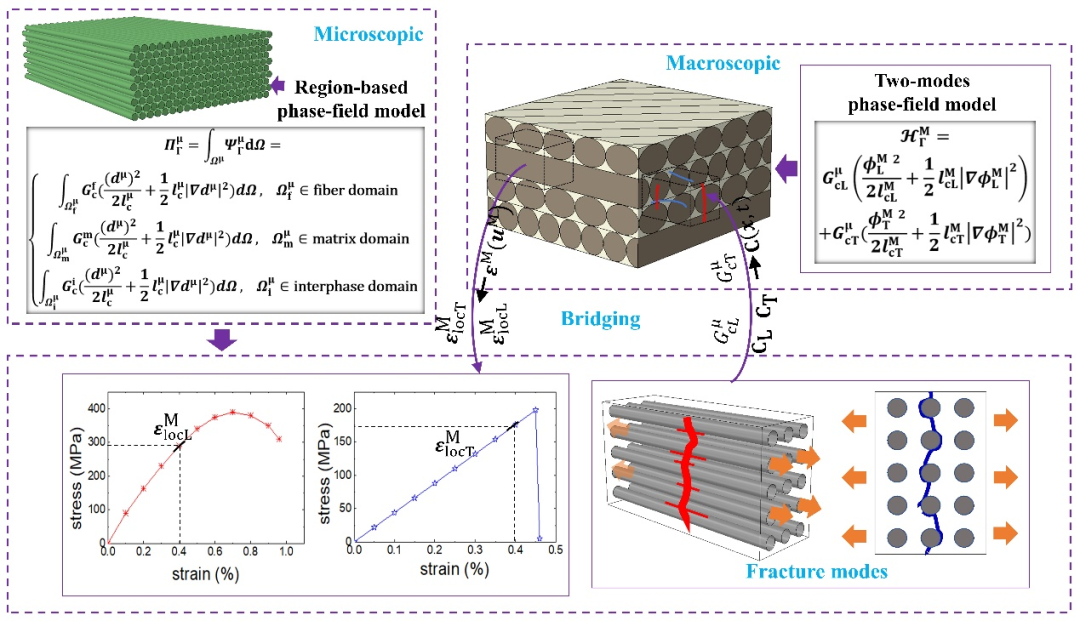
Figure 1 Schematic diagram of the collaborative multiscale phase-field model for trans-scale fracture evolution calculation of fiber-reinforced composites
Taking the in-plane tension of needled carbon/carbon composites as an example, the calculation results of the CMPF fracture model are presented. When the fiber in the microscale model bears load axially, cracks usually nucleate first in the matrix. The matrix cracks propagate through the interface andpenetrate intothe interiors of the fiber filaments,ultimately leading to an axial fracture mode where the fiber filaments are cut off, forming a flat fracture surface. This predicted failure pattern shows good agreement with the experimental results. When the fiber in the microscale model bears load transversely, the most easily nucleated matrix cracks propagate, affected by the fiber distribution, and eventually converge to form a main matrix crack. Thisresults in a transverse fracture mode of matrix cracking, which is consistent with the fracture morphology observed by SEM. In addition, the calculated load-bearing curve on the main axis in the microscale model will be called in real time during the calculation of the macroscale model to reshape the material stiffness matrix of the integration point.
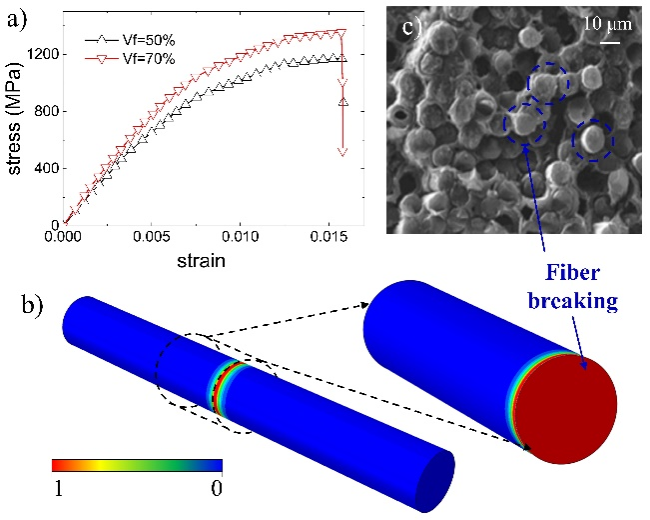
Figure 2 Fracture behavior of the axial main axis at the microscale: a) Stress-strain curve; b) Fiber filament breaking; c) Fiber filament breaking observed by SEM experiment
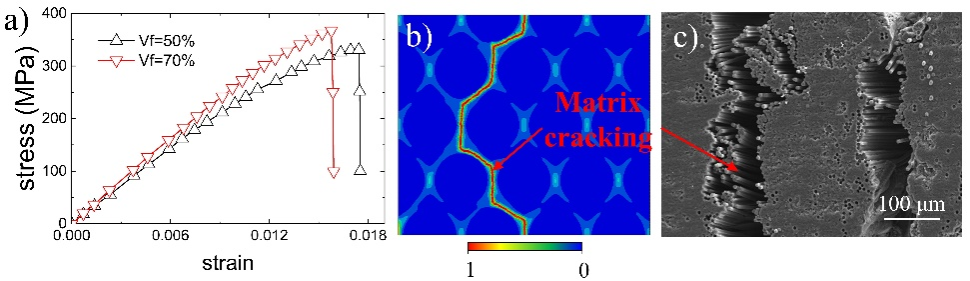
Figure 3 Fracture behavior of the transverse main axis at the microscale: a) Stress-strain curve; b) Matrix cracking fracture mode; c) Matrix cracking fracture mode observed by SEM experiment
The macroscale analysis model can reflect the correlation between microscale crack propagation and the overall performance degradation of the material. The calculation results show that several local unloading phenomena occur during the loading process until the material completely loses its load-bearing capacity. The crack propagation process corresponding to the local unloading of the curve is as follows: the transverse fracture mode of fiber bundles nucleates first in the needled region, whichcorresponds at the microscaleto theonset ofmatrix cracking. These matrixcracks propagate to the boundary of the needled region and are stopped there, ending the local unloading. Once the cracks are halted, the material gradually recovers its load-bearing capacity; the matrix cracks in the needled region deflect and propagate to a certain extent along the boundary of the needled region; the transverse fracture of fiber bundles nucleates and propagates in the unidirectional cloth layer; the axial fracture of fiber bundles nucleates in the 0° unidirectional cloth layer, which maps to the microscale as fiber filament breaking. At this time, the macroscale model completely loses its load-bearing capacity and the load-bearing curve drops; the gradual decline of the load-bearing curve corresponds to the continuous nucleation and propagation of axial fracture of fiber bundles. The calculation results are in good agreement with the experimental load-bearing curve and the fracture morphology of the specimen observed by SEM. The CMPF model proposed in this study can well characterize the complex trans-scale crack propagation process in fiber-reinforced composites and reveal the correlation mechanism between material loading and crack propagation.
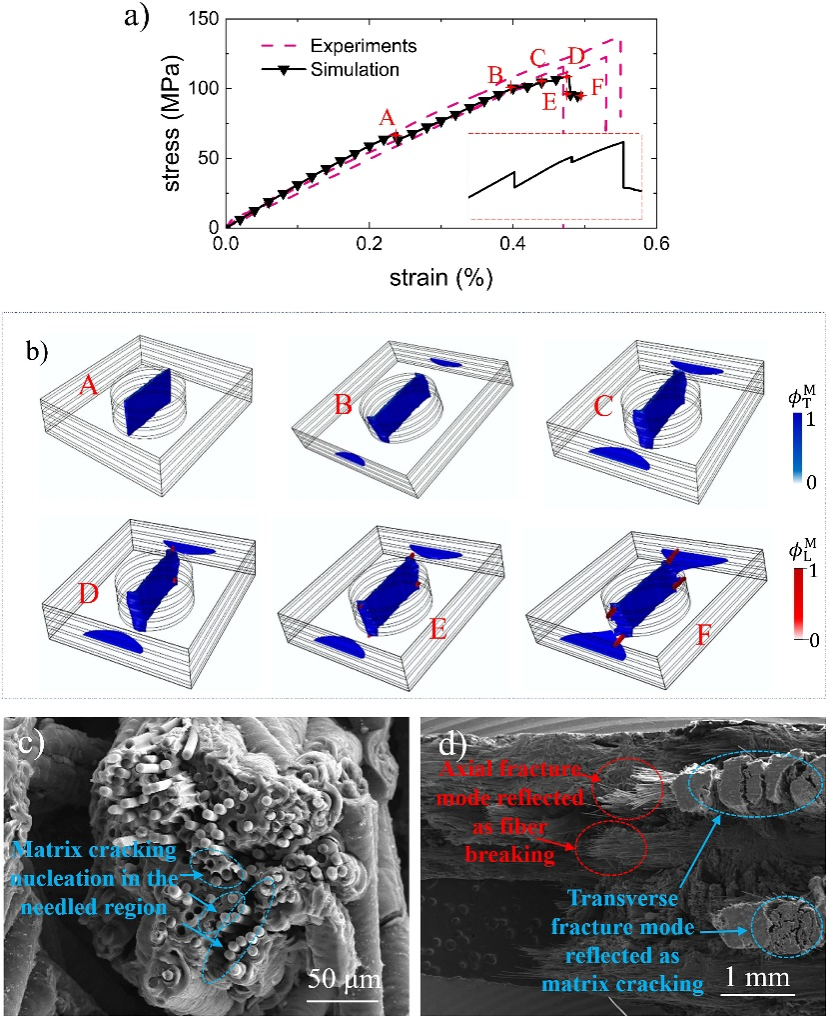
Figure 4 Fracture behavior of needled carbon/carbon: a) Macroscopic load-bearing stress-strain curve of the material; b) Trans-scale crack propagation process at the turning point of the curve; c) Matrix crack propagation mode in the needled region; d) Axial and transverse fracture modes of fiber bundles in the layer
3.Summary
This study established a characterization method and transfer strategy for crack propagation at different scales based on phase-field theory for fiber-reinforced composites. Itrevealed the correlation mechanism between the nonlinear constitutive behavior of materials and fracture evolution, andfurtherprovided an effective numerical characterization method for real-time tracking of crack propagation in fiber-reinforced composites until the formation of the final complex fracture morphology.
The research work of the paper was completed through cooperation between the College of Aerospace and Civil Engineering of Harbin Engineering University, theNational Key Laboratory of Special-Environment Composite Materials Technology of Harbin Institute of Technology, and Shijiazhuang Haishan Industrial Development Corporation. The research was supported by the National Natural Science Foundation of China, the Foundation of theNational Key Laboratory of Special-Environment Composite Materials Technology, and theFundamental Research Funds for the Central Universities.

Brief Introduction of the First Author: Song Leying, female, HanChinese.PhD, Associate Professor, Master's Supervisor. Her main research directions include multiscale simulation of mechanical properties of composite structures under complex loads, and characterization methods of crack propagation and fracture mechanisms of composites under multi-field coupling environments. She has presided over multiple projects such as the Youth Fund of the National Natural Science Foundation of China, National Defense Basic Research, and Fundamental Research Funds for the Central Universities. She has published more than 10 important academic papers and obtained 2 authorized national invention patents.





 TO TOP
 Address
 Telephone
 Postcode