In aerospace applications, traditional honeycomb structuresare often limited by insufficient in-plane shearstrength. Although honeycomb structures are widely used in key parts such as aircraft rudders and satellite platforms due to their high specific strength and high energy absorption capacity, their anisotropy and brittleness of fiber dimensions limit their performance under complex load environments. For example, aircraft wing skins are subject to bending loads caused byaerodynamic forces, and fairings are subject to inertial vibration and frictional shear loads from airflows. These working conditions require materials to have more balanced mechanical properties. To overcome the above limitations, the team published relevant research results in the top journal“Composites Science and Technology” in the field of advanced composite materials. Inspired by barnacle attachment structures, the research designed a carbon fiber pyramid honeycomb with inclined side walls. Through bionic design and process innovation, it significantly improved the shear performance of the structure while maintaining extremely low density, providing a new solution for the application of lightweight composite materials in aerospace.
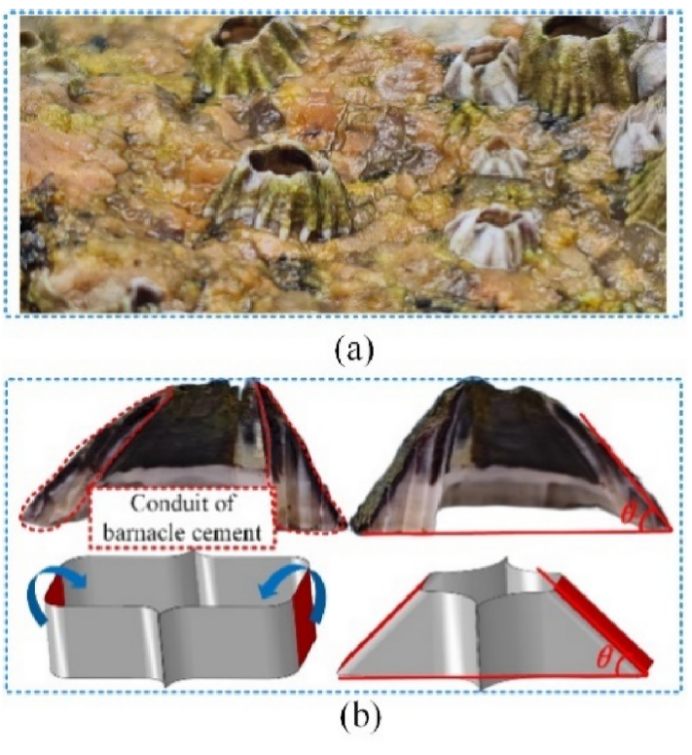
▲Pyramid honeycomb inspired by barnacle structure
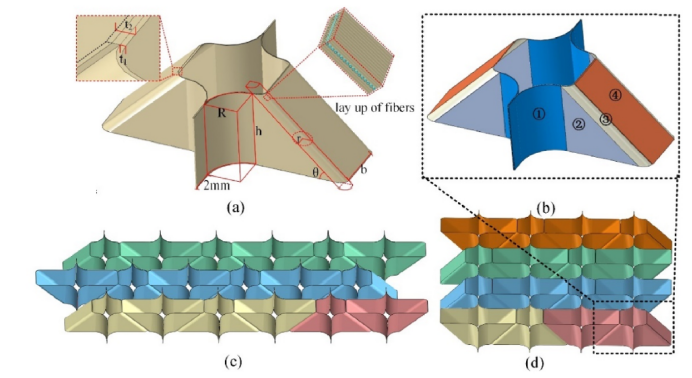
▲Schematic diagram of honeycomb structure
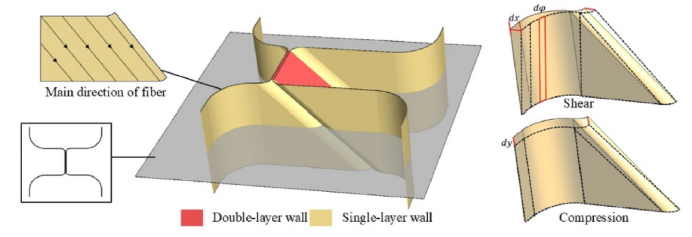
▲Schematic diagram of fiber direction and deformation of pyramid honeycomb
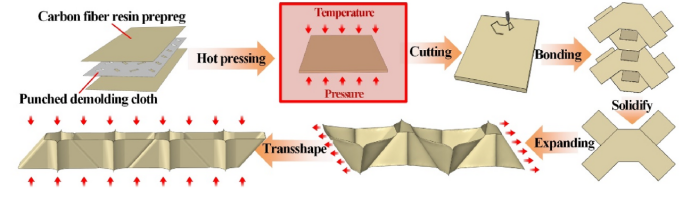
▲Preparation process of pyramid honeycomb
Through experiments and numerical simulations, this pyramid structure has been verified to exhibit excellent mechanical properties comparable to tower honeycombs. In the shear experiment, the walls sequentially undergo single-layer shearing of the honeycomb side layers,followed by bending failure of individual walls and double-wall configurations. Data shows that as the wall thickness and the width of the adhesive layer increase, the shear strength and modulus of the honeycomb increase significantly. For example, when the wall thickness is 0.07 mm and the width of the adhesive layer is 10 mm, the shear strength reaches 1.23 MPa and the modulus is 245 MPa. Compared with existing composite honeycomb structures, the pyramid honeycomb shows higher shear strength and modulus under the same density. The specific data comparison is as follows: the shear strength increases from about 0.5 MPa of the traditional honeycomb to 1.23 MPa, the shear modulus increases from about 100 MPa to 245 MPa, and the compressive strength increases from about 0.5 MPa to 0.94 MPa. These data fully reflect the structural advantage in balancing lightweight and high performance.
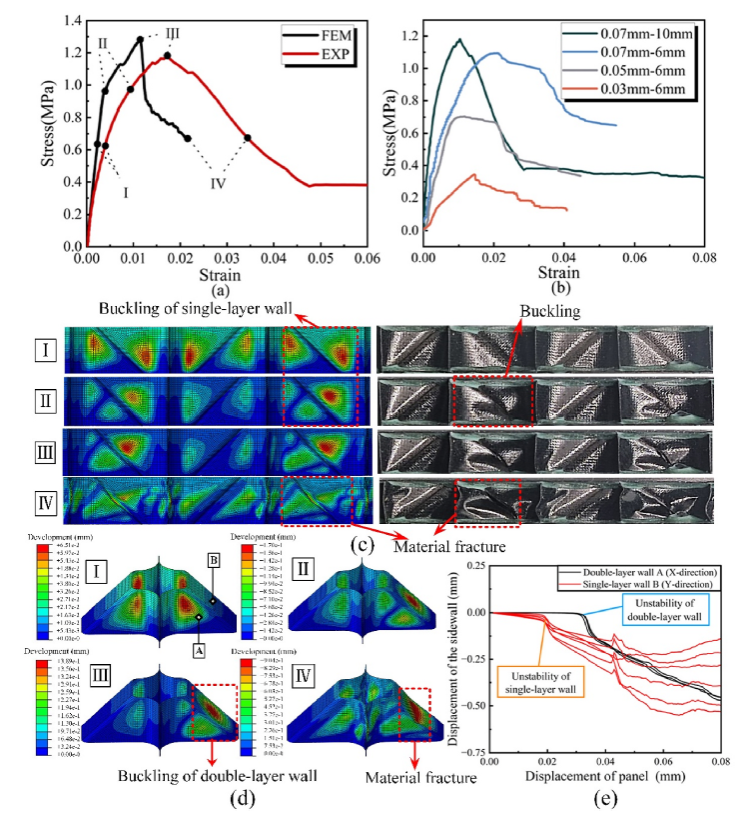
▲Shear stress-strain curve
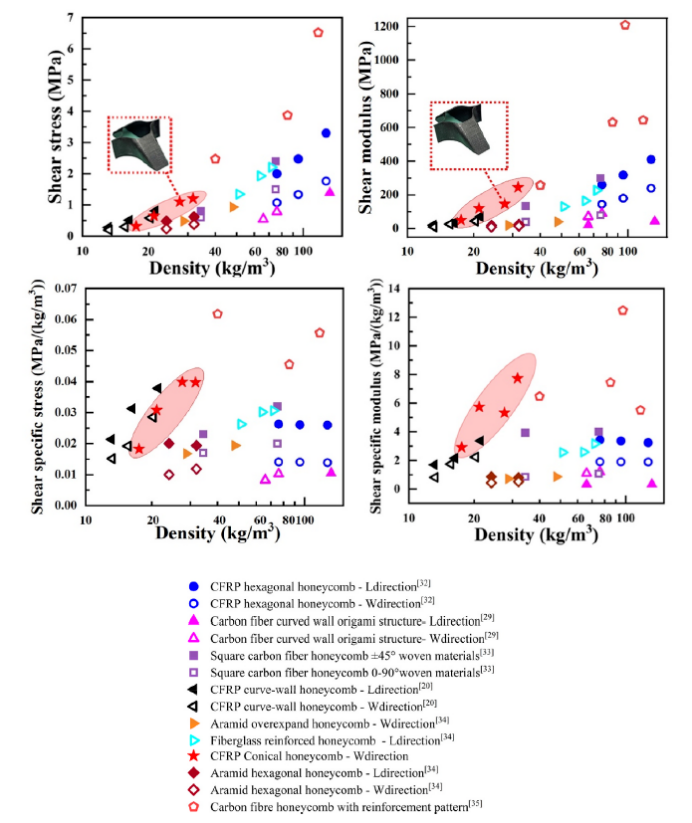
▲Comparison of Shear Properties of Composite Honeycombs
In compression tests, the honeycomb also exhibits a buckling failure sequence, with single-cell walls failing first, followed by double-cell walls. Despite springback and shape errors during fabrication, specimens with large wall thickness show lower experimental errors, indicating superior shape stability. The shear performance of this structure fills the gap in the ultra-low density range, making it suitable for components requiring high shear stiffness such as spacecraft antenna reflectors and solar panels. Additionally, its simple manufacturing process and scalability enable large-scale industrial applications.
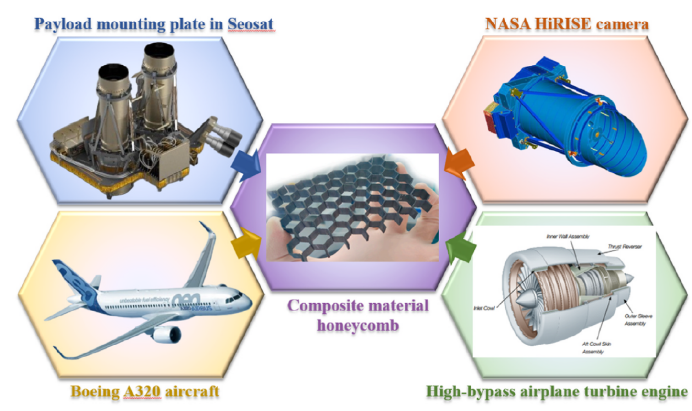
▲ Typical application fields of composite honeycomb materials
The conclusion of the article points out that through bionic wall design, the research enables the carbon inclined side fibers to effectively bear tension and compression stresses under shear loading, thereby significantly improving their shear performance; the established theoretical model is consistent with the experimental and simulation results in terms of failure mechanism and performance prediction. By controlling the deformation of composite materials and combining with the thin-layer stretching process induced by quantization, the preparation of pyramid honeycomb tubes is realized, simplifying the manufacturing process of complex structures. Compared with existing honeycomb composites, the pyramid honeycomb has higher shear strength and modulus, filling the gap in high-performance shear structures in the field of extremely low density. This research not only provides new ideas for the design and manufacturing of composite honeycomb materials, but also promotes the development of lightweight structural materials in aerospace.





 TO TOP
 Address
 Telephone
 Postcode